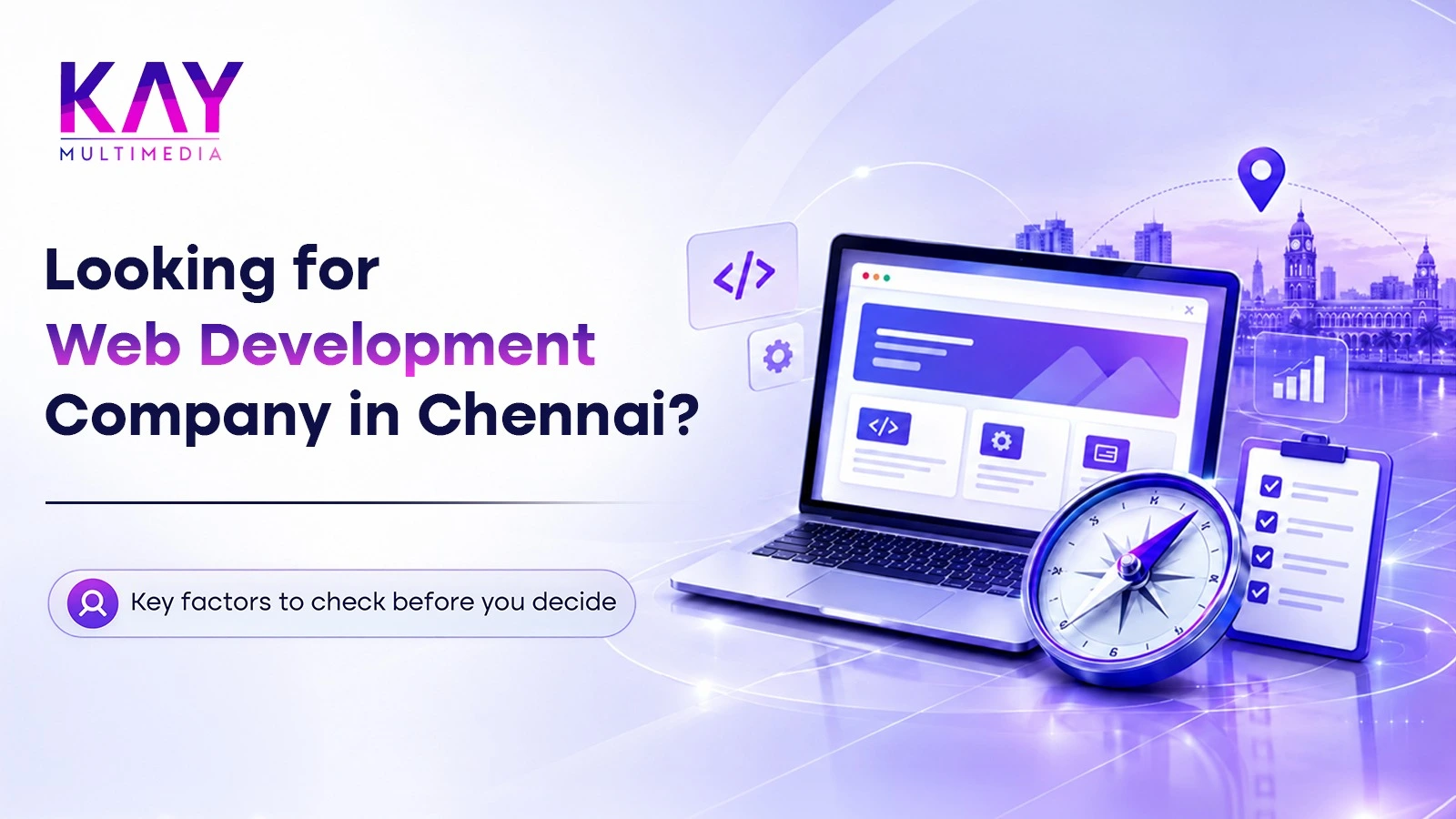
Choosing the best web development company in Chennai requires more than comparing prices or looking at attractive portfolio images. The right company should understand your business goals, users, technical requirements, search visibility and long-term growth plans.
A capable Website Development Company in Chennai will help you select the right technology, create a smooth user experience, develop secure functionality and prepare the website for future expansion. It should treat your website as a business asset not simply a collection of pages.
How Do You Choose the Best Web Development Company in Chennai?
Choose a web development company by evaluating its:
- Relevant portfolio and industry experience
- Technical and platform expertise
- Understanding of SEO and website performance
- UI/UX and mobile-development capabilities
- Security and quality-testing process
- Project communication and transparency
- Website ownership terms
- Post-launch maintenance and support
- Ability to connect development with business outcomes
Before signing a contract, request a detailed proposal covering the scope, features, timeline, technology, deliverables, costs, ownership and support.
Why Does Choosing the Right Web Development Partner Matter?
Your website may be the first place where a potential customer interacts with your business. It influences whether visitors trust your company, understand your services and take the next step.
A professionally developed website can help your business:
- Establish credibility
- Generate enquiries or online sales
- Explain products and services clearly
- Attract relevant organic traffic
- Deliver a consistent mobile experience
- Integrate with CRM, analytics and other systems
- Scale as your business grows
A poorly planned website can produce the opposite result. Slow pages, confusing navigation, weak security and difficult content management can increase costs and limit future growth.
1. Define Your Website Requirements First
Before contacting an agency, clarify what the website must achieve. A clear requirement makes it easier to compare proposals and prevents unnecessary features from increasing the cost.
Start by answering these questions:
- Is the primary objective lead generation, e-commerce, bookings, education or customer support?
- Who is the target audience?
- What pages and features are required?
- Does the website need payment, CRM, ERP or third-party API integrations?
- Who will manage the content after launch?
- Are multiple languages required?
- What are the expected launch date and budget range?
- Which business results will determine success?
A professional development company should refine these requirements during discovery rather than immediately recommending a platform or quoting a fixed package.
2. Examine the Company’s Portfolio Carefully
A portfolio reveals the agency’s design quality, technical range and experience. However, screenshots alone are not enough. Visit some of the live websites and assess how they work.
Check each project for:
- Mobile responsiveness
- Loading performance
- Clear navigation
- Functional forms and calls to action
- Consistent branding
- Accessible text and controls
- Secure browsing through HTTPS
- Logical page and content structure
Look for projects with requirements similar to yours. For example, an e-commerce business should evaluate product filters, carts, payment flows and mobile checkout. A B2B company should examine service-page clarity, lead forms and CRM integration.
3. Evaluate Technical Capabilities
The best technology is not necessarily the newest or most complex option. It is the one that supports your requirements, budget, security needs and future plans.
Ask the company which technologies it recommends and why. Depending on the project, its capabilities may include:
- WordPress or another content management system
- PHP or Laravel development
- React-based interfaces
- E-commerce development
- Database architecture
- Payment-gateway integration
- CRM and ERP integration
- Custom APIs
- Cloud deployment
- Website migration
- Maintenance and performance optimisation
A dependable Website Development Company in Chennai should explain technical decisions in business language. It should also identify the limitations, ongoing costs and maintenance needs of the recommended solution.
4. Confirm That SEO Is Included from the Planning Stage
SEO should begin before development not after the website has been launched.
Website architecture, URLs, headings, navigation, internal links, mobile performance, structured data and crawlability can all affect how efficiently search engines discover and understand a website.
Ask whether the development process covers:
- Search-friendly URL structures
- Editable title tags and meta descriptions
- Logical heading hierarchy
- Crawlable internal links
- XML sitemap generation
- Robots.txt configuration
- Canonical tags
- Redirect planning during redesigns
- Image compression and alt text fields
- Schema markup where appropriate
- Google Analytics and Search Console setup
Google advises website owners to create helpful, reliable, people-first content. Your agency should therefore balance technical SEO with content that genuinely answers customer questions.
If you would like to understand how website discoverability differs from wider brand awareness, read KAY Multimedia’s earlier guide: Website Visibility vs. Brand Visibility: What’s the Difference?.
5. Prioritise Speed and Core Web Vitals
A website must do more than look attractive. It should load quickly and respond smoothly across devices.
Ask prospective agencies how they handle:
- Image compression
- Modern image formats
- Browser and server caching
- Code optimisation
- Unnecessary scripts and plugins
- Content delivery networks
- Hosting configuration
- Database performance
- Layout stability
- Ongoing performance monitoring
Google’s Core Web Vitals guidance evaluates real-world loading performance, responsiveness and visual stability. These metrics should be tested during development and after deployment.
Request performance reports for representative pages instead of accepting a general promise that the website will be “fast.”
6. Check Mobile Usability and Accessibility
Your website should work properly on mobile phones, tablets, laptops and desktops. Responsive development involves more than shrinking the desktop layout.
A strong mobile experience should provide:
- Readable text without zooming
- Touch-friendly buttons
- Simple navigation
- Optimised images
- Accessible forms
- Visible calls to action
- Stable layouts
- Fast loading on mobile networks
The development team should also consider accessibility. Meaningful headings, keyboard-friendly controls, descriptive form labels, suitable colour contrast and image alternatives make a website easier to use for a wider audience.
Ask which devices, browsers and screen sizes will be tested before launch.
7. Understand the Development Process
A structured process improves communication, reduces rework and creates clear approval points.
A typical web development process should include:
- Discovery and requirement analysis
- Competitor and audience research
- Sitemap and functionality planning
- Wireframes and UI/UX design
- Content preparation
- Front-end and back-end development
- Integration and data migration
- Functional, responsive and security testing
- Client review and approval
- Deployment, training and maintenance
Ask who will manage your project, how frequently progress will be shared and how change requests will affect the budget or timeline.
8. Review Security and Quality Assurance
Security should be built into the project rather than added shortly before launch.
Discuss how the agency approaches:
- SSL and HTTPS
- Secure authentication
- Role-based access
- Input and form validation
- Software and plugin updates
- Data backups
- Malware protection
- Payment security
- Privacy and cookie requirements
- Recovery procedures
The quality-assurance process should test forms, links, user journeys, integrations, browser compatibility, mobile layouts, performance and error handling.
For projects that collect personal or payment information, ask the agency to explain its security responsibilities and any responsibilities that remain with your organisation or hosting provider.
9. Clarify Ownership and Access
Website ownership can become a serious issue if it is not documented in advance.
The proposal or agreement should specify who owns:
- The domain name
- Hosting account
- Website source code
- Design files
- Written and visual content
- Database
- Premium themes, plugins and licences
- Analytics and Search Console accounts
Your company should receive the appropriate administrator access, credentials, documentation and backups. Also confirm whether the website can be transferred to another provider if your requirements change.
10. Compare the Complete Cost, Not Just the Initial Quote
Website-development prices vary according to scope, technology and complexity. A business website, e-commerce store and custom web application cannot be evaluated using the same pricing model.
Costs may be affected by:
- Number of pages and templates
- Custom UI/UX design
- Content creation
- E-commerce functionality
- Payment integrations
- CRM or ERP integration
- User accounts and dashboards
- Data migration
- SEO requirements
- Hosting and licences
- Maintenance and support
Request an itemised proposal showing inclusions, exclusions, payment stages and recurring costs. A low initial quote may become expensive if essential features, testing, content migration or support are excluded.
11. Ask About Post-Launch Maintenance
A website requires attention after it goes live. Software updates, backups, security monitoring, performance checks and content changes are ongoing responsibilities.
Before selecting a provider, ask:
- What support is included after launch?
- Is there a warranty period for development issues?
- How are support requests submitted?
- What are the usual response times?
- Are updates and backups included?
- Is emergency support available?
- How is additional work priced?
- Will performance and security be monitored?
Choosing a Website Development Company in Chennai that offers dependable post-launch support can protect your investment and reduce operational disruption.
Questions to Ask Before Hiring a Web Development Company
Use this checklist during your agency discussions:
- Have you completed projects similar to ours?
- Can we view relevant live websites?
- Which technology do you recommend and why?
- Will the website be custom-built or template-based?
- How will technical and on-page SEO be handled?
- How do you test mobile usability and performance?
- What security measures are included?
- Who will manage the project?
- What information and content do you need from us?
- What is included in the quotation?
- Who owns the code, accounts and website assets?
- What maintenance is available after launch?
- How will project delays and change requests be handled?
- What analytics and conversion tracking will be installed?
- How will the website support future growth?
Warning Signs to Watch For
Be cautious when a company:
- Guarantees first-position Google rankings
- Provides a quote without understanding your requirements
- Cannot show relevant live work
- Avoids discussing ownership
- Recommends technology without explaining why
- Has no documented testing process
- Treats SEO, accessibility or security as unnecessary extras
- Offers an unrealistically short delivery schedule
- Does not define post-launch support
- Communicates vaguely about costs and deliverables
Clear answers and documented expectations are important indicators of a reliable working relationship.
Why Choose KAY Multimedia?
KAY Multimedia provides website development and digital solutions for startups, SMEs and enterprises. Its development capabilities include business websites, custom websites, e-commerce platforms, WordPress development, CMS solutions, website redesigns and maintenance.
As a Chennai-based digital partner, KAY Multimedia combines UI/UX, responsive development, SEO-friendly architecture, integrations and ongoing digital marketing capabilities. This coordinated approach can help businesses create websites that support visibility, customer experience and lead generation.
Explore KAY Multimedia’s web development services in Chennai to review its capabilities and development approach.
Frequently Asked Questions
What does a website development company in Chennai do?
A website development company plans, designs, develops, tests, launches and maintains websites or web applications. Its services may include corporate websites, e-commerce stores, CMS platforms, custom applications, integrations, redesign and technical support.
How do I choose the best web development company in Chennai?
Compare relevant experience, live portfolio projects, technical skills, SEO knowledge, development process, security, communication, ownership terms, pricing and post-launch support. Select the company that best understands your business objectives and users.
How much does website development cost in Chennai?
The cost depends on the number of pages, design complexity, platform, custom features, integrations, content, e-commerce requirements and maintenance. Request an itemised proposal based on a clearly defined scope.
How long does it take to develop a website?
A standard business website may take several weeks. E-commerce websites and custom applications usually require longer. The final timeline depends on functionality, integrations, content readiness, testing and approval speed.
Should SEO be included during website development?
Yes. Search-friendly architecture, crawlable navigation, metadata controls, page speed, mobile usability, internal links, redirects and structured data should be considered during planning and development.
Will I own my website after launch?
Ownership depends on the contract. Confirm in writing that your company will receive the agreed rights and access to the domain, hosting, source code, database, content, analytics and other essential assets.
Does a local Chennai web development company offer an advantage?
A local company can make consultations and market discussions more convenient. However, location should be evaluated alongside technical capability, communication, experience, support and understanding of your customers.
Make an Informed Decision
The best web development partner is not necessarily the agency with the lowest quote or the largest portfolio. It is the company that understands your business, recommends appropriate technology, communicates transparently and remains accountable after launch.
Evaluate each proposal using the same criteria: business fit, technical expertise, SEO readiness, usability, security, ownership, support and total cost. This approach will help you choose a Website Development Company in Chennai that can create a dependable foundation for long-term digital growth.
Ready to Plan Your Website?
Whether you need a corporate website, e-commerce store, website redesign or custom web application, KAY Multimedia Solutions can help you turn your requirements into a secure, responsive and growth-focused digital platform.
Contact KAY Multimedia to discuss your website goals and request a solution aligned with your audience, features, budget and growth plans.




 Call Now

