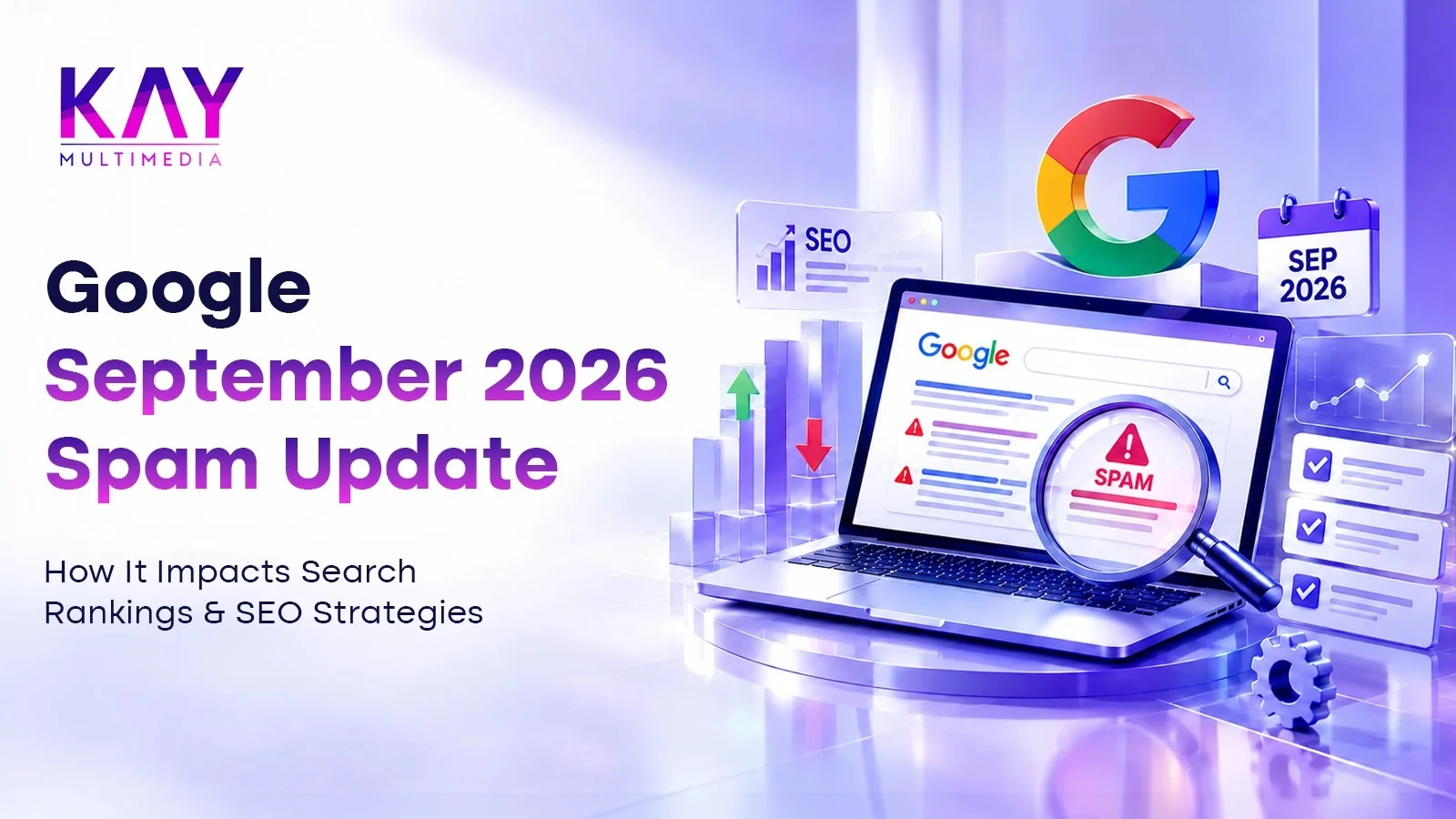
Google search rankings are constantly evolving and major spam updates can create noticeable changes in organic visibility. The Google September 2026 Spam Update is one such development that SEO professionals, website owners and businesses need to monitor carefully.
Google began rolling out the September 2026 Spam Update on September 24, 2026. The update applies globally and across all languages, with the rollout expected to take up to two weeks.
For businesses that depend on organic search traffic, ranking fluctuations during this period can naturally raise concerns. However, a sudden decline in rankings does not necessarily mean that a website has received a penalty.
Understanding what the update does, how it can influence rankings and what SEO teams should review can help businesses respond appropriately instead of making unnecessary changes.
What Is the Google September 2026 Spam Update?
The Google September 2026 Spam Update is an improvement to Google's automated systems for detecting websites and SEO practices that violate its search spam policies.
Google regularly updates these systems to improve the quality and reliability of its search results. Its spam-detection systems are designed to identify practices intended primarily to manipulate rankings rather than provide genuine value to search users.
Google has not announced that the September 2026 update targets one particular spam technique. Therefore, website owners should avoid assuming that a single SEO practice is responsible for every ranking change occurring during the rollout.
The broader message remains clear: sustainable SEO should focus on creating useful content and strong website experiences rather than attempting to manipulate search algorithms.
How Does the September 2026 Spam Update Affect Search Rankings?
The update can affect search rankings as Google's systems reassess websites and individual pages against its spam policies.
During the rollout, businesses may notice:
- Keyword positions moving up or down
- Changes in organic impressions
- Increases or decreases in organic clicks
- Traffic fluctuations on individual landing pages
- Reduced visibility for certain search queries
- Competitors gaining or losing positions
- Changes in organic leads and conversions
These changes should always be analyzed in context.
A page losing a few ranking positions for several days, for example, is not enough evidence to conclude that Google considers the website spam.
Why Can Rankings Fluctuate During a Google Spam Update?
Search rankings are influenced by numerous factors, including content relevance, competition, search intent, technical performance, website authority and Google's ranking systems.
When a major update is rolling out, Google's systems may reassess how pages should appear for different queries. As a result, some websites can experience temporary ranking volatility.
That is why SEO teams should avoid making major website changes immediately after noticing a ranking drop.
Instead, examine whether the decline:
- Started around September 24, 2026
- Affects the entire website or only specific pages
- Is concentrated around particular topics or keywords
- Corresponds with a decline in impressions, clicks or both
- Could be connected to indexing or technical issues
- Continues after the update has completed
This approach provides far more useful information than reacting to daily keyword movements.
What SEO Practices Should Businesses Review?
Although Google has not identified one specific spam technique as the target of this update, businesses should regularly review their websites against Google Search spam policies.
Google's policies address practices including keyword stuffing, link spam, scaled content abuse, cloaking, site reputation abuse and other methods intended to manipulate search visibility.
Here are some of the most important areas businesses should examine.
1. Keyword Stuffing
Keywords remain an important part of SEO because they help search engines and users understand the topic of a page. Problems arise when keywords are repeated unnaturally for ranking purposes.
For example, a business targeting Digital Marketing Company in Chennai should incorporate the phrase naturally where it is contextually relevant.
Using the exact phrase repeatedly in every paragraph, heading, image description and anchor text does not improve the reader's experience.
Modern SEO should focus on topical relevance, related concepts, entities, search intent and genuinely useful information rather than keyword repetition.
2. Scaled Low-Value Content
Publishing hundreds of pages does not automatically result in greater organic visibility.
Google's scaled content abuse policy addresses large volumes of content created primarily to manipulate search rankings rather than provide meaningful value to users.
This principle applies regardless of whether content is produced by humans, AI tools, automation or a combination of methods.
AI-assisted content is therefore not automatically a problem. The important question is whether the finished content provides original value.
Businesses using AI as part of their content workflow should ensure pages contain accurate information, useful explanations, relevant expertise, original insights and clear value for the intended audience.
3. Manipulative Link Building
Backlinks can contribute to website authority and discoverability, but not every backlink is beneficial.
Businesses should be cautious about link-building strategies created primarily to manipulate rankings, including excessive link exchanges, automated link creation, paid links intended to pass ranking value and large-scale low-quality directory submissions.
A sustainable approach focuses on earning relevant links through valuable content, digital PR, research, partnerships, useful resources and genuine industry visibility.
4. Site Reputation Abuse
Businesses should also examine third-party content published on their domains.
The issue is not simply whether content comes from another company or contributor. The purpose, quality, oversight and relationship between that content and the host website matter.
Website owners should therefore regularly audit third-party sections of their websites and ensure that content exists primarily to benefit their intended audience rather than exploit the site's existing search reputation.
5. Scraped and Unoriginal Content
Republishing information from other websites with only minor wording changes provides little reason for users or search engines to prefer your page.
Original content does not simply mean replacing words with synonyms.
Businesses should add something meaningful to the topic through expert explanations, first-hand experience, examples original data, research, case studies, comparisons, processes or practical recommendations.
What Should You Do If Your Rankings Drop?
A ranking decline during the September 2026 Spam Update should trigger analysis before action.
Start by reviewing performance in Google Search Console. Compare data from before and after September 24 and examine:
- Organic clicks
- Search impressions
- Average positions
- Queries losing visibility
- Landing pages losing traffic
- Device performance
- Country-level performance
- Changes in click-through rates
Google's Search Essentials can also help website owners understand the technical requirements, spam policies and core practices relevant to appearing in Google Search.
Next, determine whether the decline is sitewide or limited to particular pages.
If only a small group of pages has lost visibility, review those pages individually. Ask whether they still satisfy search intent, provide enough original value, match what users are searching for and remain technically accessible to search engines.
If the decline is widespread, a broader SEO audit may be necessary.
Why Content Quality Matters More Than Ever
SEO is no longer about placing an exact-match keyword a certain number of times on a page.
Search-focused content should answer real questions, satisfy user intent, demonstrate relevant expertise and make information easy to understand.
Businesses should therefore create pages that explain their products and services clearly, address customer concerns, demonstrate experience and provide information that visitors can actually use.
For example, a Digital Marketing Company in Chennai should not rely solely on location-based keywords to compete in search results. A well-planned SEO content strategy can help businesses build topical relevance through useful service pages, supporting blogs, industry insights, strategic internal linking and content designed around real search intent.
Quality also extends beyond individual articles. Businesses should consider how pages work together to establish expertise around important topics.
How Should SEO and AEO Strategies Adapt?
SEO and Answer Engine Optimization (AEO) increasingly overlap.
Traditional SEO helps content become discoverable through search engines, while AEO focuses on structuring information so that search and AI-powered answer systems can easily understand and surface useful answers.
Businesses should therefore create content that provides direct answers to specific questions.
Useful AEO practices include:
- Using descriptive question-based headings
- Providing concise answers immediately after important questions
- Defining technical concepts clearly
- Structuring long topics into logical sections
- Supporting factual claims with trustworthy sources
- Using lists where they improve readability
- Covering related questions around the main topic
- Keeping information accurate and up to date
- Demonstrating real expertise rather than simply summarizing existing pages
Instead of creating an article around only one keyword, businesses should build comprehensive resources that address the broader search intent surrounding a topic.
How Can Businesses Build a Safer Long-Term SEO Strategy?
A sustainable SEO strategy should not depend on finding ways around Google's spam-detection systems.
Businesses should instead build organic visibility through a combination of useful content, technical SEO, topical authority, internal linking, legitimate backlinks and positive user experiences.
A structured SEO content strategy in Chennai can help businesses identify relevant search topics, create stronger content clusters, optimize important commercial pages and connect informational content with services that match user needs.
This approach also makes websites less dependent on individual keywords.
For example, rather than publishing numerous pages targeting slight variations of the same keyword, a business can create a comprehensive service page supported by high-quality articles answering related customer questions.
Can a Website Recover After a Google Spam Update?
Recovery may be possible when genuine problems are identified and corrected, but businesses should not expect immediate results.
If a website has practices that conflict with Google's spam policies, the priority should be fixing the underlying issue rather than trying to find a quick ranking workaround.
Depending on the situation, this could involve:
- Improving or removing low-value content
- Consolidating overlapping pages
- Correcting misleading optimization
- Reviewing potentially manipulative link practices
- Improving technical accessibility
- Strengthening original content
- Reviewing third-party content
- Improving internal linking and website structure
After improvements are made, Google's automated systems may need time to reassess the website.
SEO recovery should therefore be viewed as a process rather than a one-time change.
Don't Assume Every Ranking Drop Is Caused by the Spam Update
This is one of the most important points for website owners.
A ranking decline happening during a Google update does not prove that the update caused it.
Organic traffic can change because of:
- Competitors improving their content
- Changes in search demand
- Seasonal trends
- Technical SEO problems
- Indexing issues
- Website migrations
- Internal linking changes
- Content updates
- Search intent shifts
- Changes elsewhere in Google's ranking systems
SEO teams should therefore investigate multiple possible causes before drawing conclusions.
Correlation with the September 2026 Spam Update should be treated as a starting point for investigation, not proof of causation.
SEO Checklist During the September 2026 Spam Update
While the update continues to roll out, SEO teams should:
- Monitor Google Search Console without overreacting to daily fluctuations
- Compare organic performance before and after September 24, 2026
- Identify the pages and queries responsible for significant changes
- Review content for usefulness, accuracy originality and search intent
- Check pages for unnatural keyword repetition
- Review backlink patterns for potentially manipulative practices
- Audit large-scale and AI-assisted content for genuine user value
- Check third-party content for site reputation risks
- Investigate technical SEO and indexing problems separately
- Review internal linking between important pages
- Avoid deleting or rewriting large sections of a website without evidence
- Continue improving content for users rather than algorithms alone
Frequently Asked Questions
What is the Google September 2026 Spam Update?
The Google September 2026 Spam Update is an update to Google's spam-detection systems. It is intended to improve Google's ability to identify websites and practices that violate its Search spam policies. The rollout began on September 24, 2026 and applies globally across all languages.
How does the September 2026 Spam Update affect rankings?
Websites may experience changes in keyword rankings, impressions, clicks and organic traffic while Google's systems reassess search results. A ranking decline during the rollout does not automatically mean a website has violated Google's spam policies.
Does a ranking drop mean my website has been penalized?
No. A ranking drop alone is not proof of a spam penalty or violation. Search visibility can change because of competition, technical issues, changing search demand, content quality, search intent and other ranking systems. Website owners should investigate the affected pages and queries before determining the likely cause.
Does Google penalize AI-generated content?
AI-generated or AI-assisted content is not automatically considered spam simply because AI was used. The greater concern is publishing large amounts of low-value or unoriginal content primarily to manipulate search rankings. Businesses using AI should apply human review, fact-checking, expertise and original value before publishing.
Should I change my SEO strategy immediately after a ranking drop?
Major changes should generally follow diagnosis rather than panic. Identify which pages and queries changed, check technical and indexing issues, evaluate content quality and determine whether there is evidence of a broader problem before making significant changes.
How can a Digital Marketing Company in Chennai help after a Google update?
A Digital Marketing Company in Chennai can analyze ranking and traffic changes, review Google Search Console data, audit content and technical SEO, assess backlinks, identify affected pages and develop an improvement strategy based on evidence rather than short-term ranking fluctuations.
The effectiveness of that work depends on the quality of the analysis and implementation, so businesses should focus on transparent, guideline-aligned SEO practices rather than promises of immediate ranking recovery.
Final Thoughts
The Google September 2026 Spam Update reinforces an important principle in modern search optimization: sustainable organic visibility should come from helping users rather than attempting to manipulate ranking systems.
Businesses should use the rollout period to evaluate content quality, backlink practices, technical health, keyword usage, internal linking and overall compliance with Google's Search spam policies.
For brands looking for a Digital Marketing Company in Chennai, the focus should be on building an SEO strategy around useful content, genuine authority, strong technical foundations, ethical optimization and measurable user value.
Google updates will continue to change how search results are evaluated. Businesses that invest in helpful content, technical quality, genuine expertise and a structured SEO strategy will be better prepared to adapt as search continues to evolve.





 Call Now

