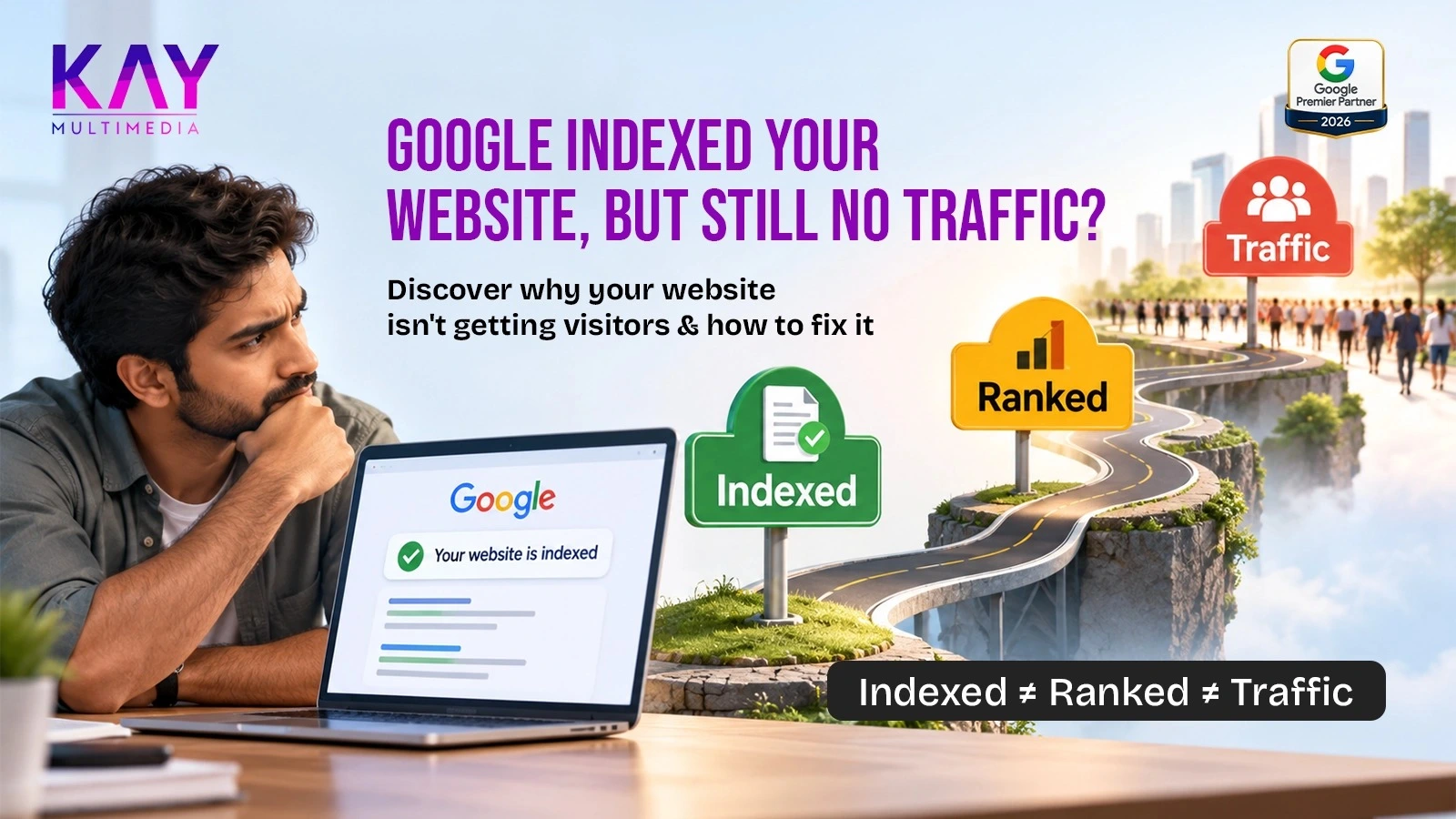
Your website is live. Google has indexed your pages. You've invested time and money into creating content, designing your website and building your online presence.
But there's one frustrating problem.
Your website is getting little to no organic traffic.
Sound familiar?
Many businesses assume that once Google indexes their website, visitors will automatically start arriving. Unfortunately, that's not how search engines work.
Getting indexed on Google doesn't mean your website will rank on the first page or attract customers.
Indexing is only the beginning. Your website must also compete for relevant search queries, satisfy search intent and give users a compelling reason to click.
In this article, we'll explore why your indexed website isn't generating traffic and how the right SEO strategy can turn search visibility into business opportunities.
What does it mean when Google indexes your website?
Google indexing means that Google has discovered, analyzed and stored information about a webpage in its search index, making it eligible to appear in relevant search results.
However, being indexed doesn't guarantee high rankings or organic traffic.
Google Search generally involves three important stages:
- Crawling: Google discovers your website through links, sitemaps and other sources.
- Indexing: Google analyzes the page and may add its information to its index.
- Serving and Ranking: Google selects and orders relevant results when someone performs a search.
According to Google Search Central's official explanation of how Google Search works, appearing in search results depends on more than simply making your website accessible to Google.
Think of it this way.
Indexing means your business has been added to the directory. Ranking determines whether customers can actually find you.
And that brings us to the real problem.
7 reasons your website is indexed but still getting no Traffic
1. Your website is indexed but not ranking for relevant keywords
One of the biggest reasons websites receive no organic traffic is poor keyword visibility.
Your website might be indexed, but if it appears far below competing websites, very few users will discover it.
For example, imagine you own a digital marketing agency in Chennai.
You want your website to appear when potential customers search for:
- Best Digital Marketing Company in Chennai
- SEO services in Chennai
- Digital marketing agency near me
- Google Ads agency in Chennai
- Digital marketing services for small businesses
If your website doesn't rank prominently for relevant searches, indexing alone won't generate meaningful traffic.
How to fix it:
Start with proper keyword research. Identify the terms your potential customers actually search for and create pages that match their needs.
Focus on relevant primary keywords, supporting long-tail queries and local search intent.
Instead of trying to rank every page for the same broad keyword, develop a clear keyword strategy that targets specific customer requirements.
2. Your content doesn't match search intent
Imagine someone searches:
"Why is my website not getting traffic?"
They expect practical explanations and actionable solutions.
But what if your webpage only talks about your company's history, awards and services?
Even if Google indexes that page, it may not be the most relevant answer to the user's question.
This is called a search intent mismatch.
Search intent refers to the actual goal behind a user's query.
People typically search to learn something, find a particular website, compare solutions or purchase a product or service.
How to fix it:
Before writing content, understand what the searcher wants.
If the query is informational, explain the issue clearly.
If the query is commercial, help users evaluate solutions.
For example, someone searching for the "Best Digital Marketing Company in Chennai" may want to compare agencies, understand their expertise, evaluate available services and identify a suitable business partner.
Your content should satisfy that intent rather than simply repeating the target keyword.
3. Your website has weak on-page SEO
Publishing content is not the same as optimizing it.
Even informative webpages may struggle to perform when essential on-page SEO elements are missing or poorly structured.
Common issues include:
- Generic or duplicate title tags
- Unclear heading structures
- Missing or ineffective meta descriptions
- Poor keyword placement
- Thin or repetitive content
- Unoptimized images
- Weak internal linking
For instance, a page titled "Welcome to Our Website" provides far less information about its subject than a descriptive, relevant title.
Your headings should also help readers and search engines understand what each section covers.
How to fix it:
Optimize each important webpage with a unique, descriptive title tag, a helpful meta description, a clear H1 heading, logically structured H2 and H3 headings and relevant supporting keywords.
Use descriptive image alt text where appropriate and create internal links that help visitors discover related information.
Professional SEO Content Strategy Services in Chennai can help businesses align their website content, keyword targeting and technical optimization with their search visibility goals.
4. Your website has poor technical SEO or user experience
Your content may be valuable, but technical problems can prevent your website from performing effectively.
A slow, difficult-to-navigate or poorly optimized website creates friction for visitors.
Common technical SEO issues include:
- Slow-loading webpages
- Poor mobile responsiveness
- Broken internal links
- Incorrect canonical tags
- Redirect problems
- Duplicate URLs
- Important pages that are difficult to discover
- JavaScript rendering issues
Some technical issues affect how search engines access and understand your content. Others primarily affect usability and conversions.
How to fix it:
Conduct a technical SEO audit.
Check whether your important pages are accessible, mobile-friendly and working correctly.
Review Google Search Console for indexing and crawling problems. Use performance testing tools to identify opportunities to improve loading speed and page experience.
Also ensure that your XML sitemap includes important canonical URLs and that visitors can navigate easily between relevant webpages.
A technically healthy website provides a stronger foundation for long-term organic growth.
5. Your website lacks authority and trust
Google aims to present search results that are relevant, useful and trustworthy.
If your website is new or has limited credibility within its industry, competing against established websites may be difficult.
For example, a newly launched marketing agency website might compete against agencies that have published helpful resources, earned relevant backlinks and built recognizable brands over several years.
Simply publishing a few service pages may not be enough to establish strong search visibility.
How to fix it:
Build trust through consistent, high-quality content and genuine business credibility.
Showcase relevant experience, accurate business information, real customer feedback, useful case studies and clear service explanations.
Earn backlinks naturally from relevant, reputable websites instead of purchasing spammy links.
Most importantly, publish content that genuinely helps your target audience.
Building a recognizable, reliable online presence is a long-term process.
6. You're ignoring AI search and Answer Engine Optimization (AEO)
Search behavior is evolving.
Today, users don't always search using short keywords. They also ask detailed, conversational questions through traditional search and AI-powered search experiences.
For example:
"Why is my website indexed on Google but not getting visitors?"
Or:
"How can a small business in Chennai improve its Google rankings?"
This creates an opportunity for Answer Engine Optimization (AEO).
AEO focuses on structuring information so search engines and AI-powered systems can understand it and potentially use it when answering relevant questions.
However, AI search visibility does not guarantee website visits. Some users may find the answers they need without clicking through.
How to fix it:
Create content that answers real customer questions clearly.
Use descriptive question-based headings, short direct answers, relevant examples, accurate explanations and useful FAQs.
Support important claims with reliable sources and implement appropriate structured data when it accurately represents the page.
For a deeper explanation of this changing search landscape, read our previous article: How AI Is Transforming SEO into AEO.
Combining strong SEO fundamentals with answer-focused content helps prepare your website for both traditional and AI-powered search experiences.
7. You're not monitoring your website's actual search performance
Many business owners say:
"My website isn't getting traffic."
But they haven't checked whether their website is appearing in search results.
Without proper performance data, it's difficult to identify the real problem.
That's where Google Search Console becomes essential.
You should regularly monitor four important metrics:
Impressions: How often your website appears in Google Search results.
Clicks: How many times users click your website from search results.
Click-Through Rate (CTR): The percentage of impressions that result in clicks.
Average Position: The average ranking position reported for your website or page across relevant search appearances.
For example, suppose your website receives 5,000 impressions but only 20 clicks.
That represents a CTR of 0.4%.
This doesn't automatically mean your title is poor. You should also examine query relevance, ranking positions, devices and search appearance before deciding what to change.
Alternatively, if your website receives almost no impressions, the issue may involve keyword demand, search visibility, competition or content relevance.
How to fix it:
Use Google Search Console to compare your queries, pages, impressions, clicks, CTR and average positions.
Google's official Search Console Performance Report guide explains how to analyze search performance and identify opportunities.
The goal is to make SEO decisions based on evidence instead of assumptions.
How can you increase organic traffic after Google indexes your website?
Getting indexed is just the starting point. To attract qualified visitors, your website needs an ongoing optimization strategy.
Here are the most important actions to prioritize:
- Audit your current visibility. Identify indexed pages, existing queries, impressions, clicks and ranking opportunities.
- Improve keyword targeting. Focus on search terms that are relevant to your business and customers.
- Update underperforming pages. Improve information quality, headings, search intent alignment and content usefulness.
- Strengthen internal linking. Connect related service pages, articles and resources through descriptive links.
- Optimize technical performance. Resolve important crawling, rendering, mobile usability and website performance issues.
- Build business credibility. Publish original insights, relevant examples and genuinely useful information.
- Monitor and refine. Review performance regularly and adjust your strategy based on actual results.
For small businesses organic search is only one part of a broader digital growth strategy.
Content marketing, social media, paid advertising and conversion optimization can also help attract and convert potential customers.
To understand how these channels work together, explore our previous blog, How Does Digital Marketing Help Small Businesses Grow?.
How long does it take to get traffic after Google Indexing?
There is no fixed timeline.
Some pages begin receiving organic clicks shortly after indexing, while others take weeks or months to gain meaningful search visibility. Certain pages may never attract much traffic without further improvements.
The timeline depends on several factors, including keyword competition, website authority, content relevance, search demand, technical health and the effectiveness of ongoing SEO efforts.
Rather than expecting automatic traffic after indexing, businesses should focus on steady, measurable improvements.
Why choose KAY Multimedia for SEO and Digital Marketing in Chennai?
If your website is already indexed but struggling to generate enquiries, you need more than basic keyword placement.
You need a digital strategy that connects search visibility with actual business growth.
KAY Multimedia Solutions is a Chennai-based digital marketing agency offering SEO, content strategy, Google Ads, performance marketing, social media marketing and website development services.
As a Google Premier Partner, KAY Multimedia works with businesses to develop strategies based on their industry, target audience, competition and marketing goals.
Our approach focuses on:
- Identifying gaps in website search performance
- Improving relevant organic search visibility
- Developing keyword-focused, helpful content
- Strengthening technical and on-page SEO
- Supporting SEO and AEO content strategies
- Measuring website enquiries and business outcomes
If you're searching for the Best Digital Marketing Company in Chennai, it's important to choose a partner that understands your goals and can explain how marketing activities contribute to measurable results.
At KAY Multimedia, we focus on helping businesses move beyond simply being visible online toward attracting relevant audiences and creating opportunities for sustainable growth.
Frequently Asked Questions
1. Why is my website indexed on Google but not getting traffic?
Your website may be indexed but receive little traffic because it ranks poorly, targets low-demand keywords, doesn't match search intent or has weak content and technical optimization. Google indexing makes a page eligible for search results but does not guarantee visits.
2. Does Google indexing mean my website will rank?
No. Indexing and ranking are different processes. Indexing means Google has stored information about your webpage. Ranking determines where it may appear for relevant searches.
3. How can I check why my website isn't getting organic clicks?
Use Google Search Console to review impressions, clicks, CTR, average positions and search queries. These metrics can help you identify whether the issue is low visibility, weak rankings or low click-through rates.
4. Can AEO help my website get more traffic?
AEO can improve how clearly your content answers relevant questions and support discoverability in AI-powered search experiences. However, it does not guarantee traffic because some search experiences provide answers without requiring a website click.
5. How important is internal linking for SEO?
Internal linking helps search engines discover related pages and understand website structure. It also makes navigation easier for visitors and can guide users toward relevant services and useful resources.
6. Can a digital marketing company help improve my Google traffic?
Yes. An experienced digital marketing company can audit your website, identify search performance issues, improve content targeting, resolve technical problems and develop an ongoing strategy to increase relevant organic visibility.
7. How do I choose the best digital marketing company in Chennai?
Look for relevant industry experience, transparent reporting, a clear SEO strategy, verified expertise, realistic expectations and measurable business objectives. Choose an agency that focuses on qualified traffic and conversions rather than promising guaranteed rankings.
Final Thoughts: Google Indexing is only the beginning
Your website being indexed by Google is a positive first step.
But indexing alone doesn't bring traffic. Relevance, visibility, useful content, technical performance and a consistent SEO strategy are what create opportunities for organic growth.
If your website is indexed but still not attracting visitors, don't assume that publishing more pages is the solution.
Start by understanding why your existing pages aren't performing.
Improve the areas that matter most, monitor the results and keep refining your strategy.
Your website shouldn't just exist on Google. It should help potential customers discover your business.
Is your website indexed but not generating leads?
Let KAY Multimedia Solutions help you identify what's holding your website back.
Whether you need better search visibility, stronger website content, SEO optimization or a comprehensive digital marketing strategy, our team can help you plan your next steps.
Contact KAY Multimedia Solutions and start turning your online presence into meaningful business opportunities.



 Call Now

